

Turn scattered data into one reliable basis
Data Management
Data is often scattered across various systems, applications, and departments. As long as that data is not properly consolidated, it takes a lot of time to find information, and the question remains: are the figures we are basing our decisions on actually accurate?
With good Data Management we ensure that data becomes reliable, accessible, and usable. Not only for today's dashboards and reports, but also as a solid foundation for further analysis, automation, and AI.
Discover what is possible with your data
Can you trust the data on which you base your decisions?
Up-to-date and reliable information is essential for making good decisions. Yet, organizations often work with different data sources, definitions, and versions of the same information.
Do you recognize this?
- Data is distributed across various systems.
- Reports show different figures for the same subject.
- Collecting and combining data takes a lot of time.
- It is unclear which data is current or reliable.
- Connecting new data sources is becoming increasingly complex.
- The amount of available data continues to grow.
In that case, the challenge often lies not in a lack of data, but in the way that data is accessed, stored, managed, and made available.

From separate data sources to one reliable foundation
Data Management It revolves around managing, maintaining, structuring, and securing data. The goal: to ensure that the right data is complete, reliable, and available at the right time for the people and applications that work with it.
To achieve this, we bring together data from various sources. Think of data from ERP, CRM, financial, production, or HR systems. We ensure that this data is processed in a structured manner and that definitions within the organization align.
This creates a single reliable foundation upon which you can build.

What changes when your data is well organized?
A good data environment enables more than just reliable reports.
One version of the truth
Everyone works from the same definitions and reliable data, so that there is no longer any discussion about which figures are correct.
Faster access to information
Employees and applications gain faster access to up-to-date data, without constantly relying on separate exports or files.
Less manual work
Data does not need to be manually collected, combined, and checked from various systems every time.
Ready for further growth
A good data structure makes it easier to add new data sources, dashboards, analyses, and AI applications.
Why RRS for the data management solution of TimeXtender chooses
RRS is the market leader in the Netherlands in the field of sewer cleaning and unclogging. They serve the whole of the Netherlands from 12 branches. They manage all the data they access via TimeXtender. In this short video (2.41 min) you can hear and see why RRS has opted for a data management Victa's solution.
Where do you actually store all that data?
Bringing data together also means thinking about how and where you store data. For this, for example, a data warehouse, data lake, or a combination thereof can be used.
Data warehouse
A data warehouse brings together structured data from various source systems and makes it suitable for reporting and analysis. It helps to centrally capture definitions, preserve historical data, and make information available in a consistent manner.
This allows different departments to work from the same reliable database.
data lake
A data lake is specifically designed to store large quantities of various types of data. In addition to structured data, files, documents, and other less structured data can also be stored here.
This provides more flexibility to store data that you want to use now or later for analysis, Data Science, or AI.
Or a combination?
In modern data platforms, these capabilities increasingly come together. Which configuration suits your organization depends on your current IT landscape, data sources, information needs, and future ambitions. This way, you benefit from the advantages of both.
That is why we don't start with the technology, but with what you ultimately want to be able to do with your data.


Reliable data makes more possible
Data Management is ultimately not an end in itself. The real value arises from what you can subsequently do with that data.
Think of up-to-date dashboards without manual exports. Automatic reports that are ready every morning. Analyses where information from multiple business units comes together. Predictive models that recognize patterns. Or AI applications that can use reliable business data.
The better your database is structured, the easier it becomes to take the next step.
That is why at Victa, we look beyond just the technical unlocking and storage of data. We look at the entire data chain and ensure that technology, data, and your organization's information needs are aligned.
Technology that fits your data environment
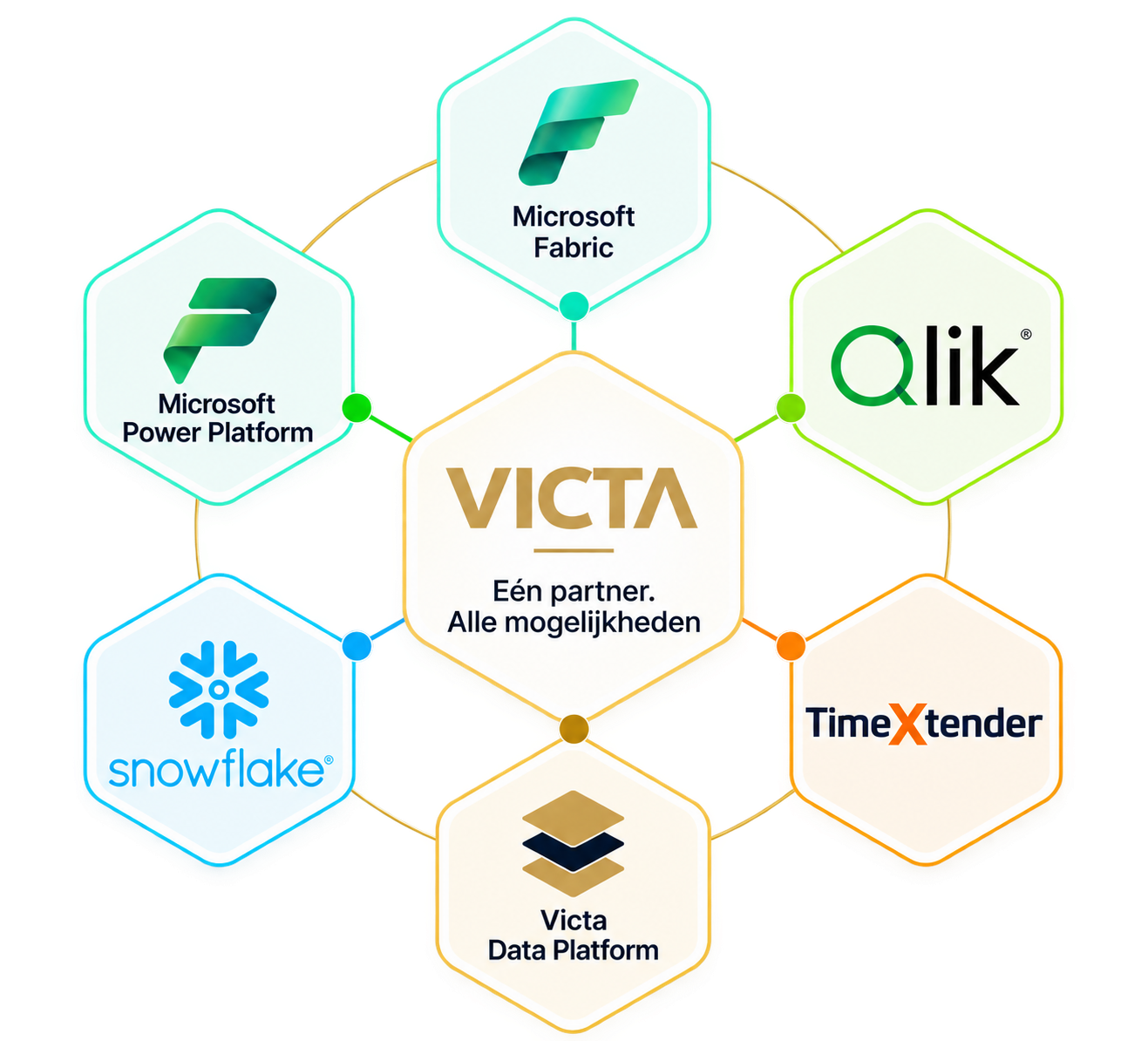
We work with various technologies and platforms for unlocking, storing, transforming, and managing data. Think of Microsoft Fabric, TimeXtender, Snowflake, Qlik and the Victa Data Platform.
The product does not determine the solution. We look at which technology aligns with your existing environment, ambitions, and the way your organization wants to work with data.
Do you not have your own data team, or do you prefer not to organize the management of your data environment yourself? With the Victa Data Platform , you get a fully managed data platform, where Victa takes the technical management and maintenance off your hands.
Curious where the greatest opportunities lie within your data environment?
You don't need to collect more data to extract more value from it. Often, the next step begins with better organizing what is already there. Contact us!